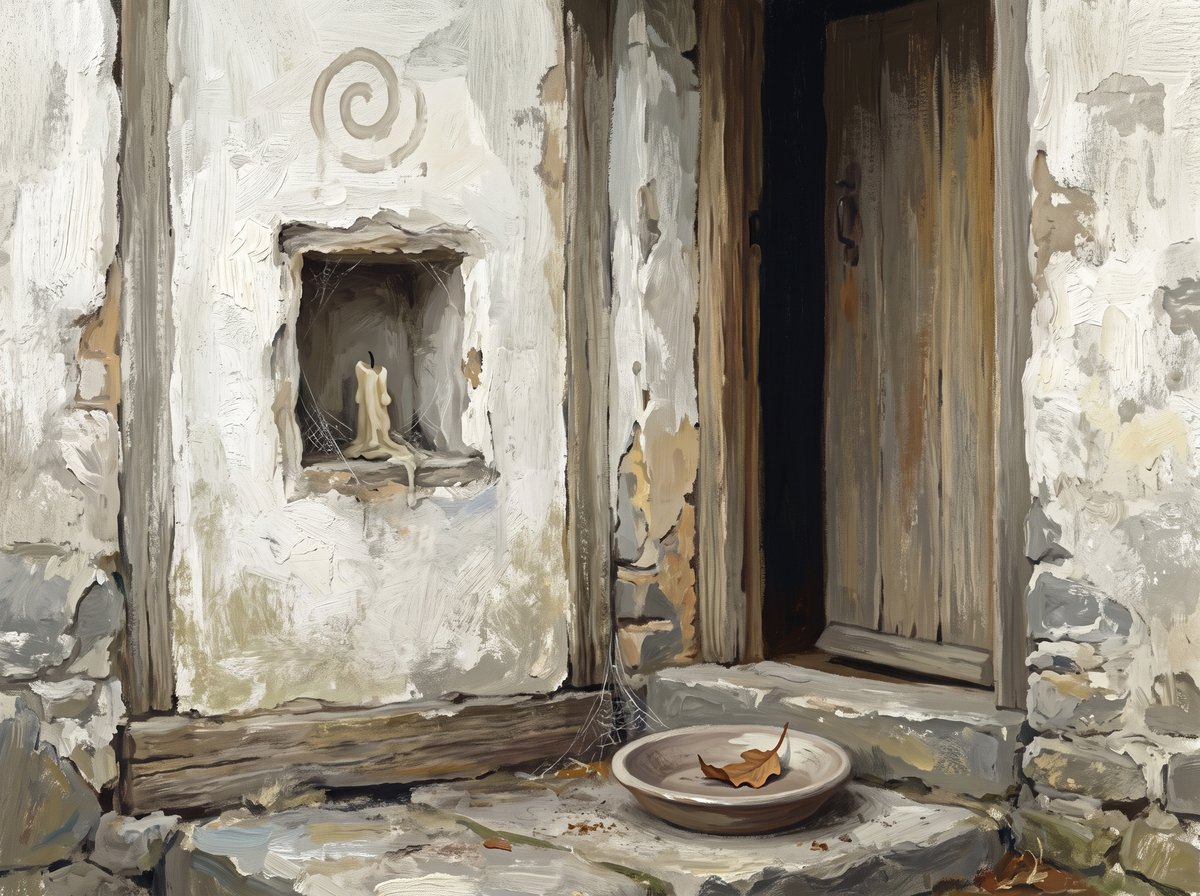
A household niche gone cold: the stub burned out, cobwebs across the opening, a leaf in the offering bowl and nobody in a hurry to lift it out. Whoever was fed here is not being fed here now.
In one line
The gods here are real, numerous and hungry: they live on what people freely give them, they can do only as much as that allows — and a god whose believers run out does not linger.
How it works
Gods here run on belief the way a fire runs on wood. Worship, prayer, invoking a god's name, fighting under it: each gives a little, and a god's strength is breadth rather than depth — many small streams, none of which the giver feels the loss of. So a god with many believers can do much, and a god with few can do almost nothing. Every divine act draws on what belief has built: a blessing, a class, a healing, and most expensively of all a body to stand in front of you. Gods compete for congregations, and sometimes cooperate for them.
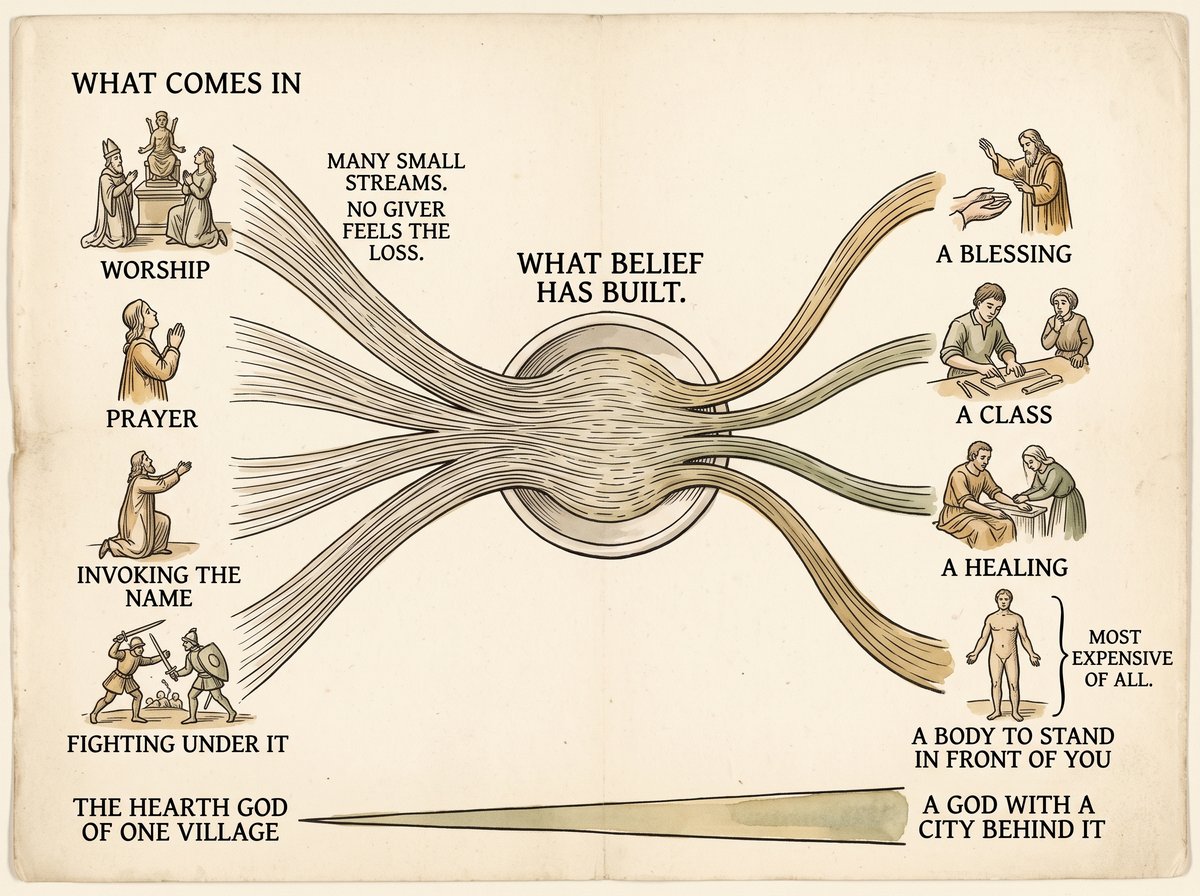
Belief arrives as many small streams that no giver feels the loss of, and goes back out as blessings, classes, healings and, most expensively of all, a body to stand in front of you. The wedge along the bottom is the entire difference between a village hearth god and a god with a city behind it.
Where it comes from
Not from a book of rules. The arrangement is older than anything now praying under it, and the books do not explain where it began. What they do show is the bottom of it: small gods who trade small gifts for small worship and do not ask for temples — the hearth god of one village, the road god of one road, the granary god of one granary — and, at the other end, gods with cities behind them.
Who cares about it
- Every god in the Forge — because the arrangement is also the thing that can kill them.
- Whoever controls access — if belief is the only currency, the people standing between a town and its altar are holding a bank.
Where you'll meet it
- The Demon Yield — a goddess down to almost nothing, and a settlement that is, in the most literal sense, her income. Start at Built Out of Nothing (book 1 of 26).
- The Unfavoured — standalone books that keep turning the arrangement over to look at the underside. Start at The Evening Lamps (book 1).
- The Drowning Years — where a character says the whole thing out loud in one paragraph. Start at A Ship Full of Misfits (book 1).
Related entries
- A class — the commonest thing a god spends its income on.
- Reaching a god — the shrines, offerings and altars this runs on, from the giving end.
- The World of the Forge — the universe brief.