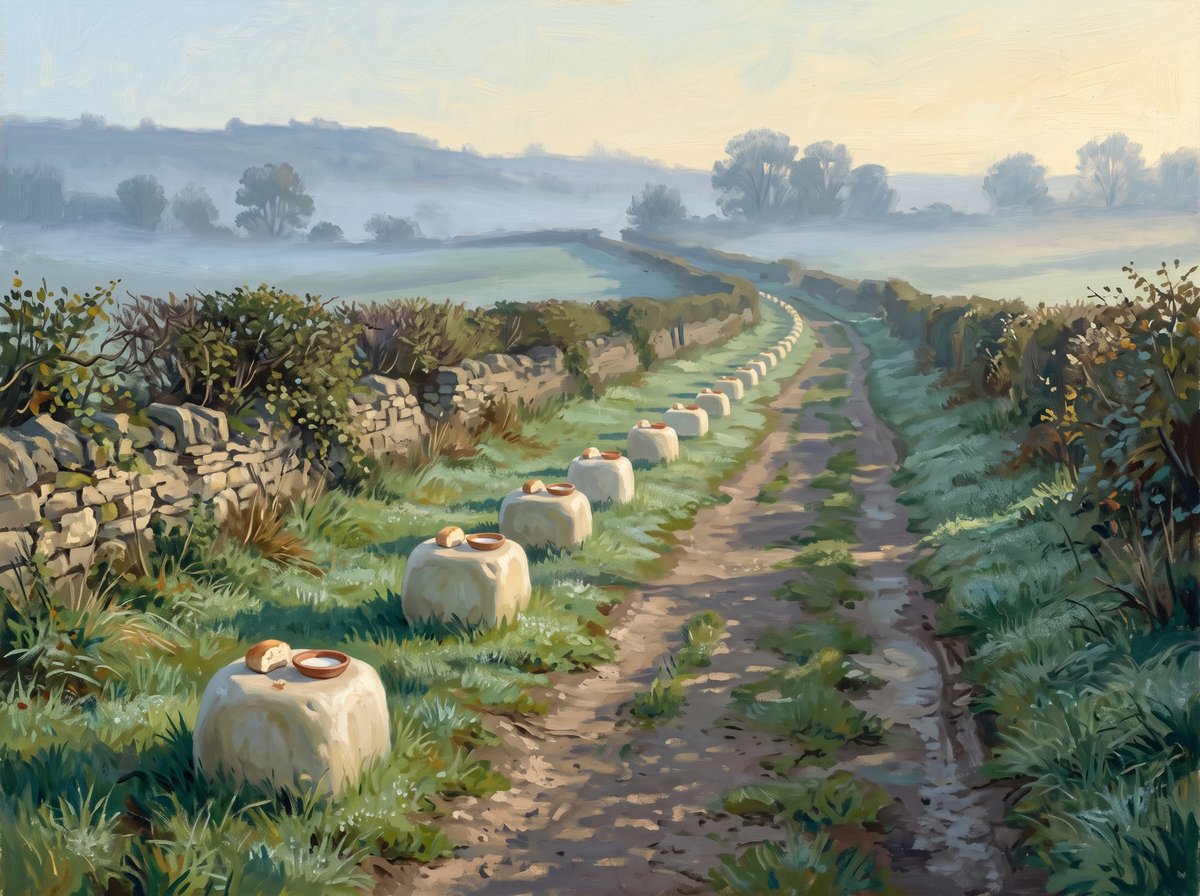
First light on the lane, and the round is already done: a crumb and a bowl of milk on every stone, the whole way along. Not one of these is a temple. That is the point of them.
In one line
Where you stand when you ask changes what the asking costs — which is why this world is covered in very small holy places, and why the large ones are worth fighting over.
How it works
Where you stand changes the price. A consecrated place gathers a god's attention in one spot, so a prayer said at a shrine is heard cheaply, while a cry in open country costs the god dearly to answer. That is what shrines are for, and it is why they are everywhere and mostly tiny: a niche beside a door, a bowl on a threshold, three stones and a candle in a refugee camp, a knee-high wax stone with a crumb of bread on the left and a thimble of milk on the right. What is given is small. Small is the point.
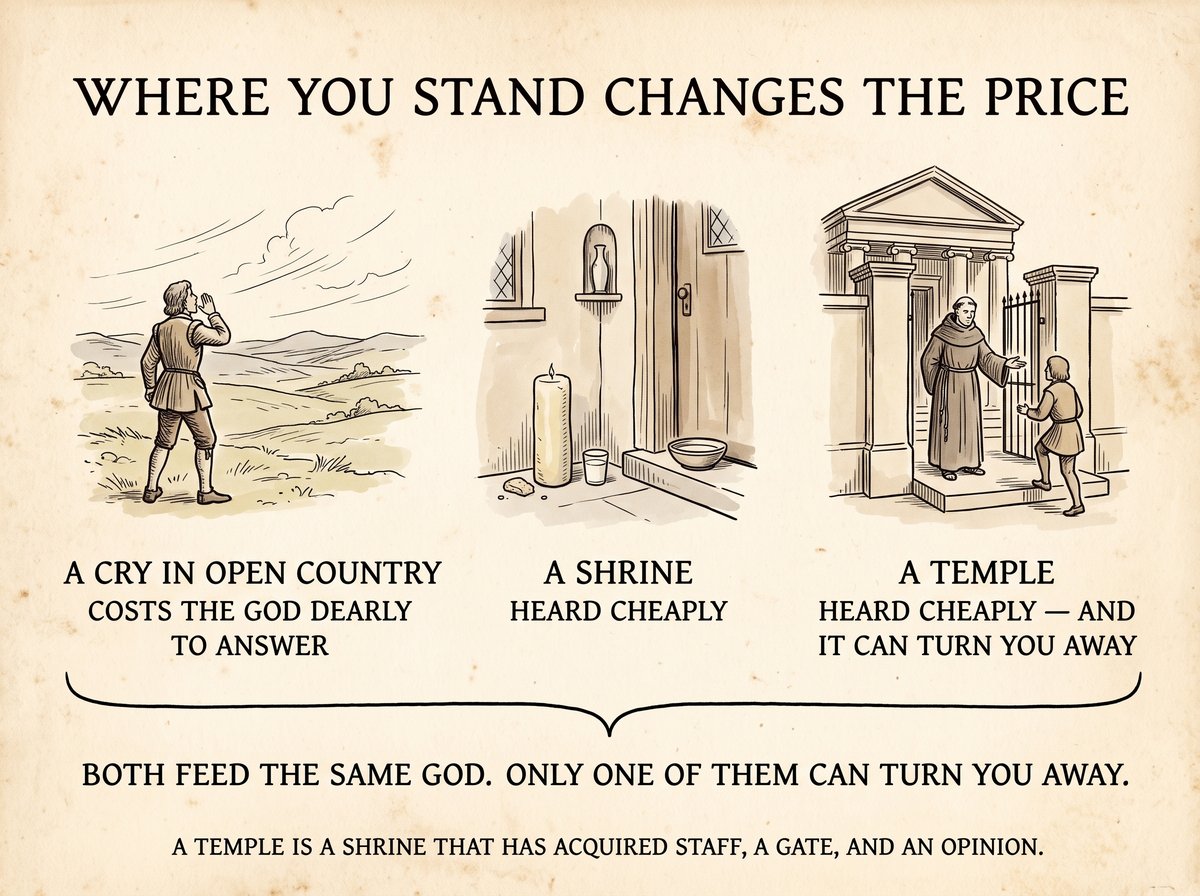
The same prayer at three prices. A cry in open country costs the god dearly to answer; a shrine and a temple are both heard cheaply. Both feed the same god, and only one of them can turn you away.
Where it comes from
The practice is older than the buildings. A temple is a shrine that has acquired staff, a gate and an opinion about who may use it, and the difference matters: the niche costs nothing and belongs to the household, while the temple belongs to whoever holds it. Both feed the same god. Only one of them can turn you away.
Who cares about it
- Everyone — which is the unusual thing about this entry: it is the one piece of the divine economy that ordinary people operate themselves, daily, without anybody's permission.
- The priesthoods — whose whole position rests on the larger end of it.
Where you'll meet it
- The Unfavoured — a man doing the motions of an office at altars that have stopped answering. Start at Answered With a Sword (book 6).
- The Demon Yield — the small end of the economy running in real time, for a goddess who needs it. Start at Built Out of Nothing (book 1 of 26).
- The Classless — the other side: a city where access to the altar is the thing being rationed. Start at The Unchosen (book 1).
Related entries
- How the gods work — the same economy from the receiving end.
- A class — the largest thing an ordinary person ever asks for, and where they go to ask.
- The World of the Forge — the universe brief.