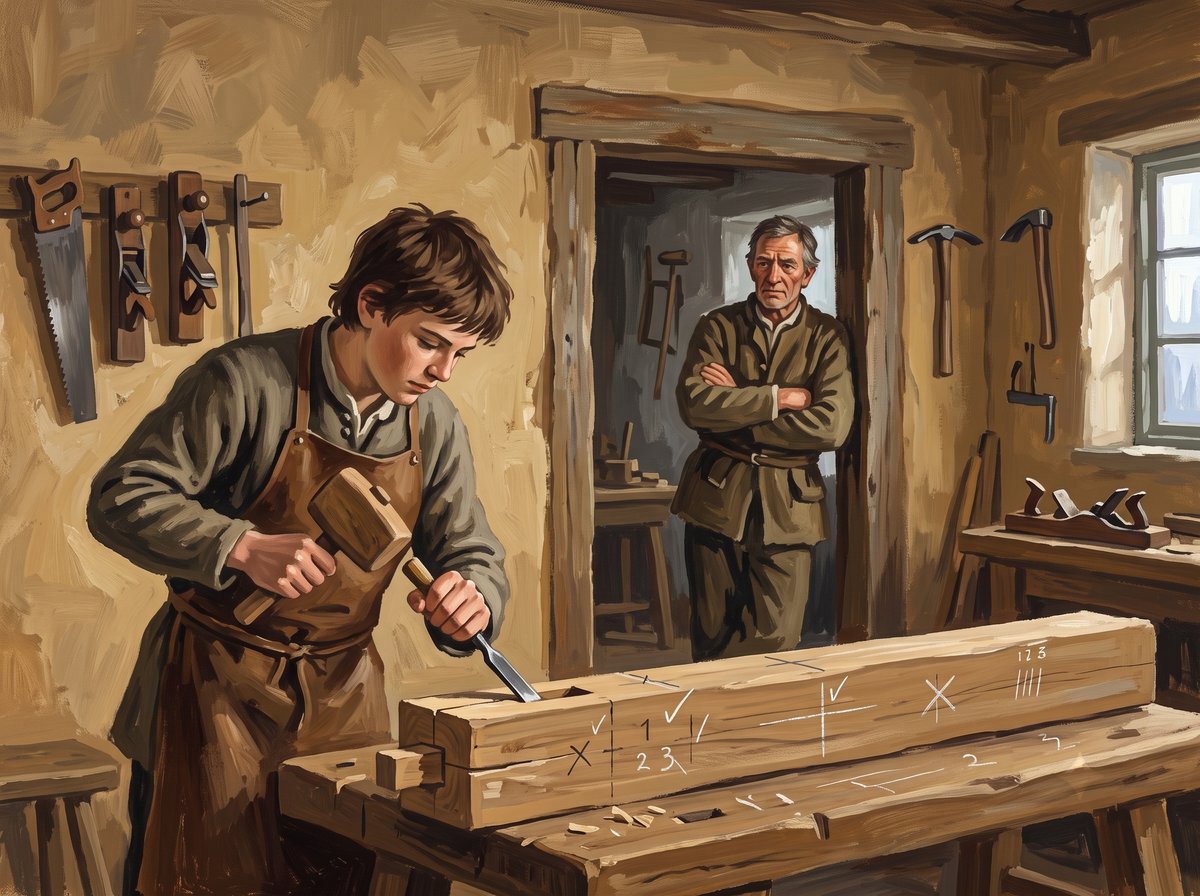
The morning after: chalk setting out marks, a mortise cut clean, and skill in hands that did not have it yesterday. The older man in the doorway got there the long way, and is watching.
In one line
A class is a god's gift and a god's bargain: real, particular ability, handed over by a named god with reasons of its own — and it can be refused, and it can go cold.
How it works
A class is granted, not chosen. A god gives it, shapes it, and can let it go quiet again. It arrives as competence a person did not train for: a steadiness in a leg that should have slipped, an eye that reads a pattern nobody taught it. It comes with an expectation attached, because the god that gave it lives on what its followers give back. Most people ask once, at a coming-of-age altar, and most are refused. The refused are not a rare misfortune. They are the majority, and the towns run on their hands.
Named classes appear all through the books. This entry does not catalogue them.
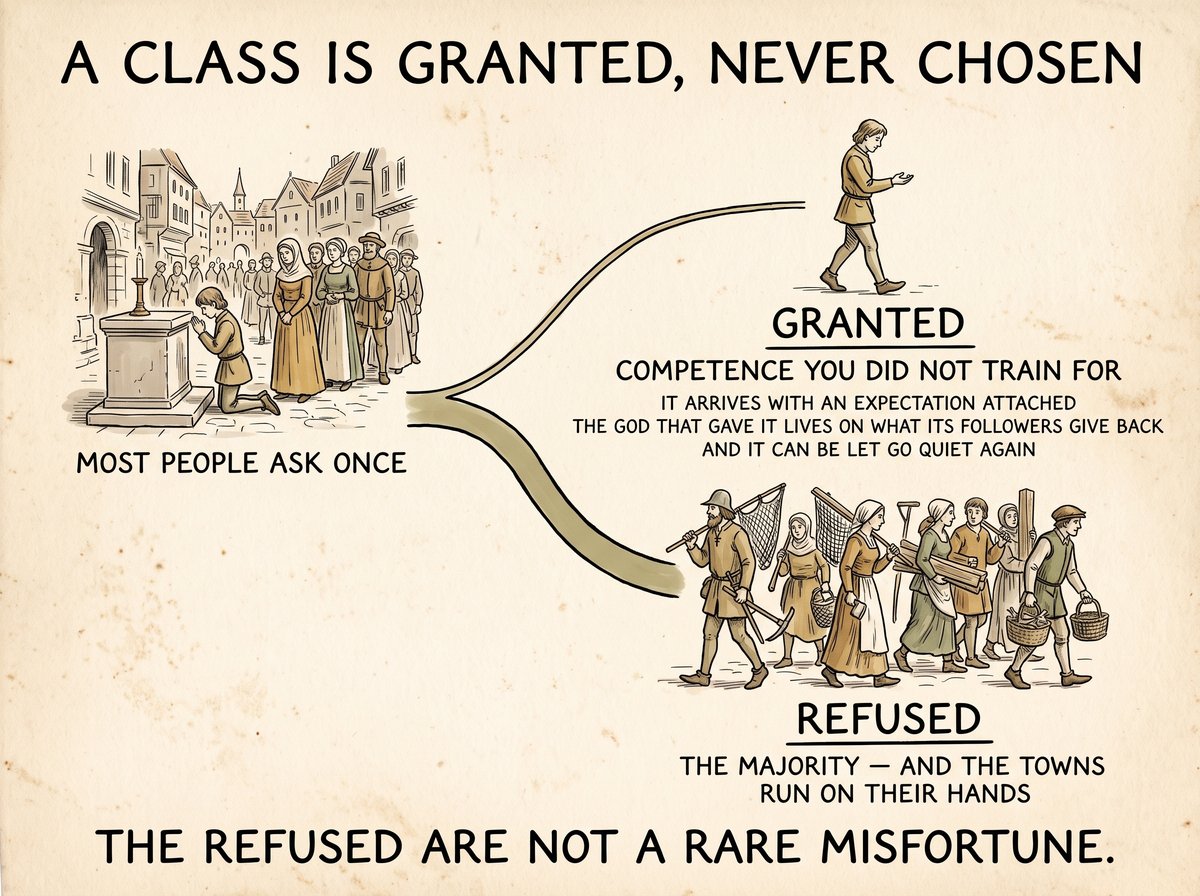
Most people ask once, at an altar, in front of everyone they know. Two roads lead out of that question, and the crowded one along the bottom is the ordinary answer rather than the sad exception: the refused are the majority, and the towns run on their hands.
Where it comes from
There is no institution behind it and no schedule. A class comes from one god, for that god's reasons, and the reasons are not published. What has grown up around it is human: the altars, the coming-of-age rite, the people who decide which altar a town may use, and the long habit of counting a person by what they were given.
Who cares about it
- The classless — everyone the altar refused, which in a port city is most of the workforce.
- Whoever controls the altars — access to the gods is worth holding, and it is held.
Where you'll meet it
- The Classless — a city where the refused do the actual work, and the rite is a Wednesday. Start at The Unchosen (book 1).
- The Demon Yield — the cornerstone of the whole Forge, where a class is a bargain struck with a goddess who has almost nothing left. Start at Built Out of Nothing (book 1 of 26).
- The Unfavoured — standalone books about people the arrangement has no place for. Start at The Evening Lamps (book 1).
Related entries
- BOB — the other gift, separate from this one, and a god may give either without the other.
- The fragments — why the same gift behaves differently in a poorer world.
- The World of the Forge — the universe brief.