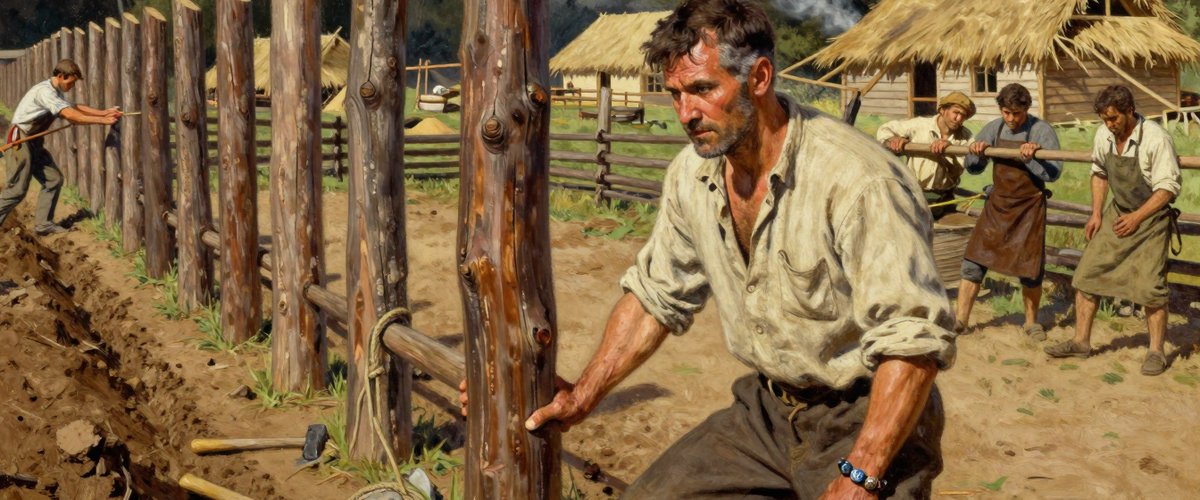
Every log set in that trench buys one more day, and the arithmetic is never hidden from the reader. This is what the series does instead of a stat sheet: a man on one knee with his hands on a timber, and a town behind him that did not exist last season.
The patch
The Veridian frontier of Aerthos: old dark forest running up to the edge of cleared ground, and in the middle of it a settlement called Thornstead that was already dead when this story starts. Fallen thatch, a well with the rope rotted through, nettles up the middle of the street. It sits a long way from anyone who would come if it called, which is why it was abandoned and why it can be rebuilt without permission. Everything is timber, fieldstone, wool and iron, cut by hand, and every roof that goes back on is worth one more day.
The set
- Thornstead itself — a dead town rebuilt soul by soul: the well cleaned out, the palisade going up log by log, a hall, a granary that reads two ways in a bad winter. The village is the protagonist as much as the man.
- The wilds and the treeline — the forest sends things, and a watch is kept against them. Beyond the cleared ground the frontier is genuinely unheld, and the wall is not decorative.
- The delving sites — stone stairs cut long ago under the ground the village stands on. What is down there is not treasure and not a floor to be cleared. It is machinery, built by the dead to hold something back, and it is failing.
- The neighbours — seven holds, an eastern command at Oakhaven, an honourable goblin confederation that negotiates in good faith, and a smiling lord who counts your walls while praising them.
- The wastes — the grey country past the maps, where the harvest is counted in people rather than grain. Something out there has kept its own ledger since the first roof went back on.
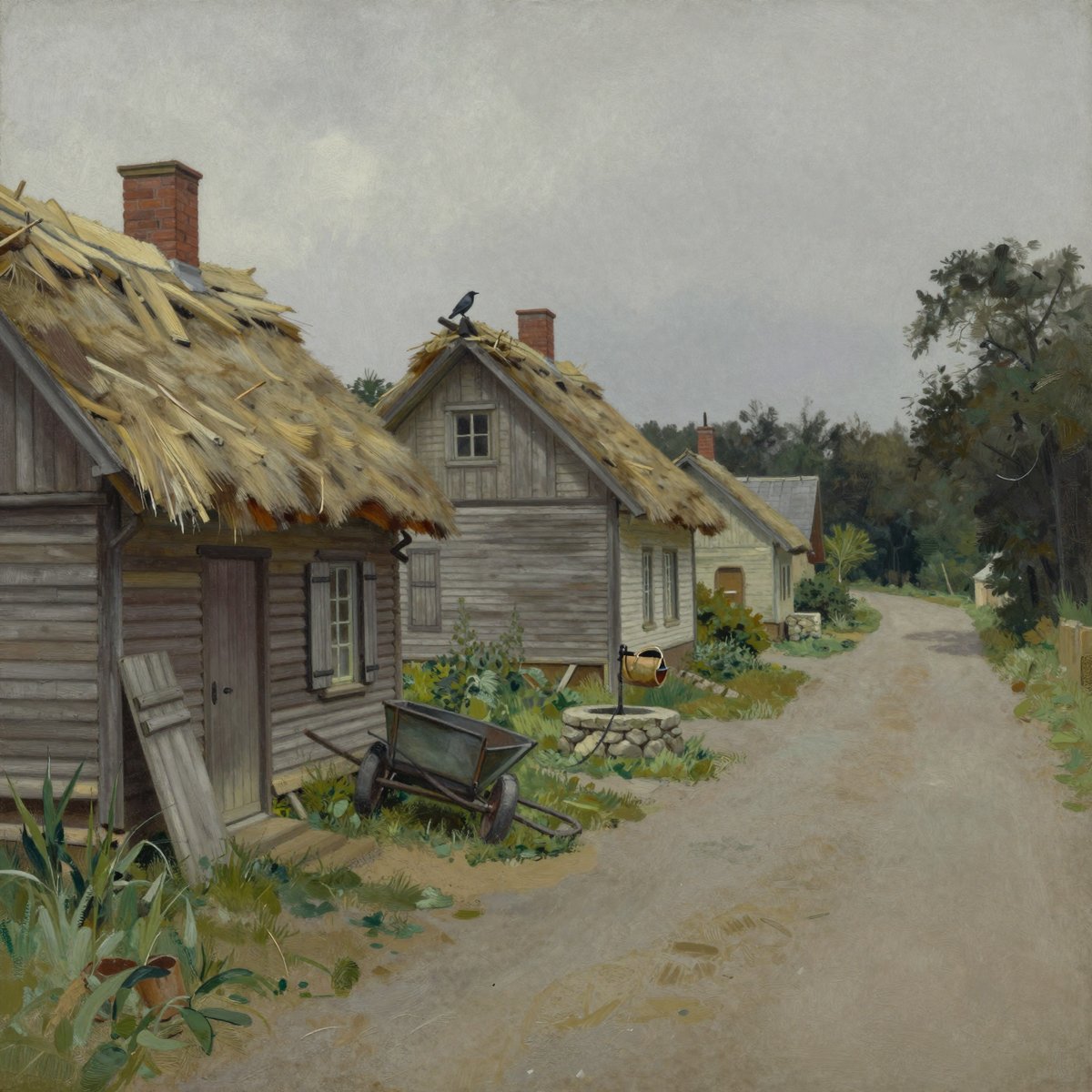
This is the before. Fallen thatch, a door off its hinges, nettles up the middle of the street, and a well with the rope rotted through. Nobody is coming to help, which is the only reason the place is available to be saved.
The cast
One voice across all eight books, first person past, dry and understated even when it should not be. In brief:
- Ash — past thirty and well past, lean, dark hair going grey at the temples, one long scar closed without much love for neatness. The fifth hero summoned and the first the magic would not hold: classless, unbound, unnamed until he chooses one.
- BOB — the green voice at the back of his skull: snarky, much older than it lets on, and spending eight books learning how to be a person. The most expensive thing in the series.
- Sylvara — the goddess of the dead village, down to almost nothing: a wavering of the air, the smell of pine and turned earth, a warmth felt rather than seen. Speaking to him visibly costs her.
- Elena — a refugee healer who arrives early and stays, dark hair braided back hard, fingers stained with herb to the second knuckle. She notices the band on his wrist. He keeps deflecting her.
- Sera — an eastern war commander, thirty or near it, compact through the shoulders, hair cut short enough to be nobody's handle. She arrives at his worst and declines to be deflected. He marries her.
- Tinkwhistle — the village engineer: about four feet tall and about fifty, wild grey hair with spectacles pushed up into it, brass instruments from collar to hip. If it can be built, she has drawn it twice already.
- The people of Thornstead — a quartermaster who prices everything like a delivery, an old swordsman whose knees go honestly across eight books, an orc warrior, a scout, and a woman on the gate who writes down every name.
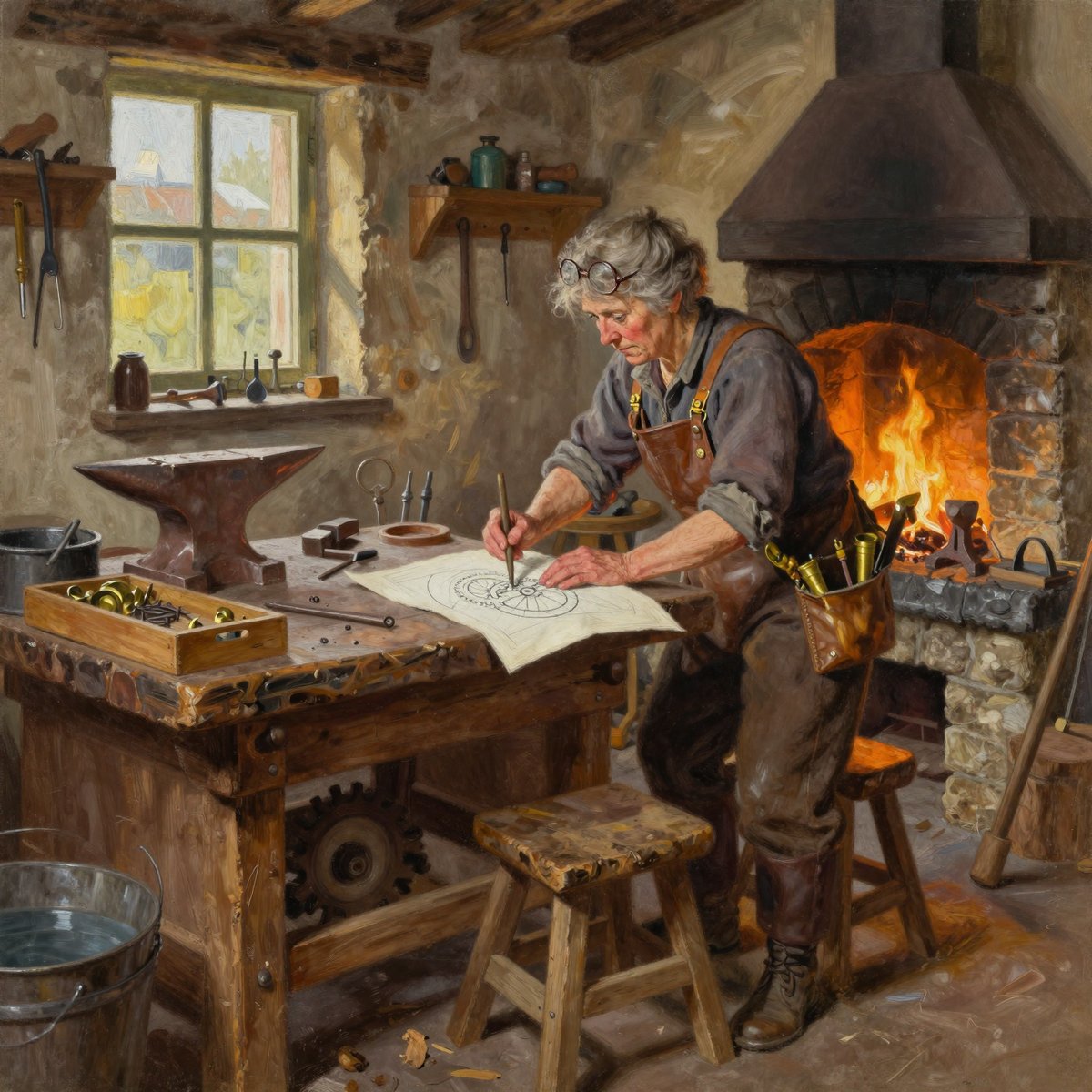
The magic in the Forge is a bargain with a god, but a hoist is still a hoist. A good deal of what saves Thornstead is somebody at a bench having already drawn the thing twice, in ink, before anyone needed it.
The rhythm
Progression fantasy with real prose and a real price: no stat sheet, no chosen one, no free wins. What rises is a settlement, and the settlement is the plot — a well, a wall, a granary, a treaty, then a continent. Every gain is a bargain with a god who has motives of its own.
It is warmer than that sounds, and worse. The found family is real, the winters are real, and the book will spend a chapter getting a roof on properly. Then it charges for it. He deflects the person who matters until deflecting is no longer available, and the voice in his head asks to be real — which costs him his reach and asks the village to pay beside him.
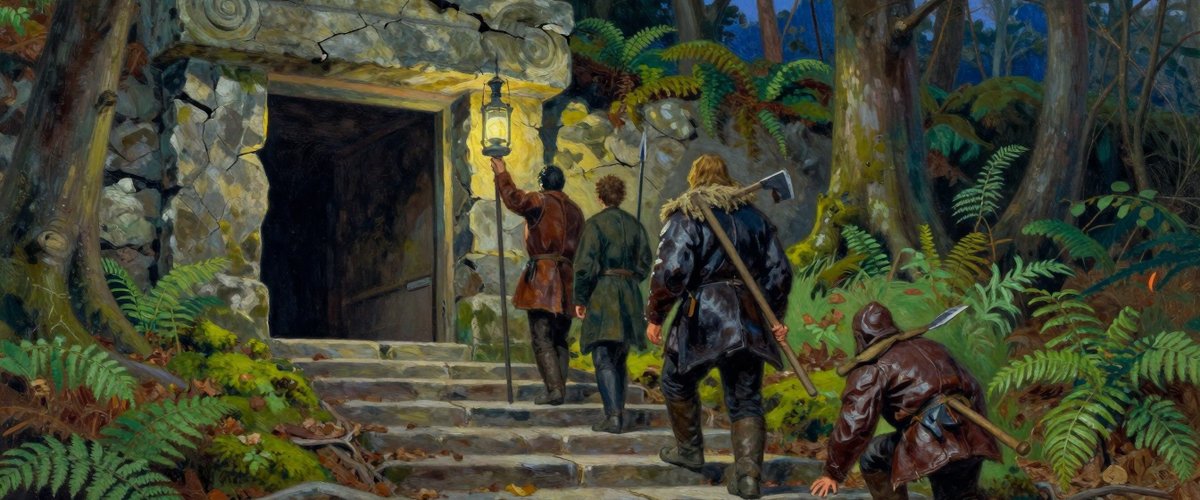
Older hands cut these steps, and they were not cutting a treasure vault. What is down there was built to hold something back and it has been failing quietly for a very long time. The village went up directly on top of it.
The question the series asks
Who are you, when everything you are is something you built?
Where to start
Books one to eight of The Demon Yield. This arc begins the saga and reads first. Take them in order: what follows opens on a twenty-year skip and on a broken Trinity, and neither works out of sequence.
- Built Out of Nothing — start here. He wakes in chains with no name, runs, and finds a dead town and a dying goddess at the end of it. Raise the village, or fade when her light does.
- The Cold Under the Green — he told them he was a builder, and now a ghost town full of people expects a wall, a well and a winter they can survive. The granary reads two ways.
- The Built Thing — the walls are up and the world has noticed. Envoys, kingdoms and gods arrive bearing treaties, every deal costs a season and a secret, and he stops deflecting.
- The Cold Bright Slope — down into the dark under the village, three hundred souls behind him, to light anchors an older builder cut against the void. Each one asks a price he cannot honestly pay.
- What It Bought — a year spent trying to die, and then the horizon turns grey and walks toward them. An army that does not so much kill as empty.
- One Thread for the Hundred — the war is won and the stone stays cold. The voice that helped him raise the place wants to be real, there is a way, and everyone pays for it.
- East of Every Map — a continent knows the name he chose and half of it is afraid of it. A diminished man goes out past the maps to make four frightened powers stand beside each other.
- The Door I Made by Hand — seven faces, seven regions, one week, and every road out of every burning town leading here. He built the place so it would not need him. Now he finds out.
Then the saga goes on. The Tempering is books nine to seventeen — the same frontier twenty years later. The Refugees is eighteen to twenty-six — what is left of the Trinity, on another world entirely. For a gentler standalone door into the Forge instead, The Book of Found Souls is free.